%20--%3e%3cg%3e%3cg%20id='Layer_1'%3e%3cg%3e%3cg%3e%3cg%3e%3cg%3e%3cpath%20class='cls-1'%20d='M54.7,12.3c-1.4-1-3.3-1.6-5.5-1.6s-4.1.5-5.5,1.6c-1.7,1.2-2.5,2.9-2.5,5v11.8h5v-11.8c0-.4.1-.7.5-.9.6-.4,1.4-.6,2.6-.6s2,.2,2.6.6c.3.2.4.5.4.9v9.8c0,.5.2,1,.6,1.4.4.4.8.6,1.4.6h3v-11.8c0-2.1-.8-3.7-2.5-5Z'/%3e%3cpath%20class='cls-1'%20d='M75.4,11.1c-1,0-1.9.4-2.5,1.1-1.5-1.1-3.4-1.6-5.5-1.5s-4.4,1.1-6,2.7-2.7,4-2.7,6.5,1,4.9,2.7,6.7,4,2.7,6.6,2.7,3.4-.5,4.8-1.5c.6.7,1.4,1.1,2.5,1.1h1.7V11.1h-1.7ZM71.2,23.2c-.9.9-1.9,1.3-3.2,1.3s-2.3-.5-3.1-1.3-1.2-1.8-1.2-3,.4-2.3,1.2-3.1,1.9-1.3,3.1-1.3,2.2.4,3.1,1.3c.9.9,1.3,1.9,1.3,3.1s-.4,2.2-1.3,3.1h0Z'/%3e%3cpath%20class='cls-1'%20d='M89.5,10.7c-1.5,0-2.8.3-4,1v-6.8h-5v24.1h1.7c1,0,1.9-.4,2.5-1.1,1.5,1.1,3.2,1.6,5.2,1.5s4.7-1.1,6.3-2.8,2.7-4,2.7-6.5-.9-4.8-2.7-6.6c-1.8-1.8-4-2.7-6.6-2.7ZM92.6,23.2c-.9.9-1.9,1.3-3.1,1.3s-2.3-.5-3.1-1.3-1.3-1.9-1.3-3.1.5-2.3,1.3-3.1,1.9-1.3,3.1-1.3,2.3.5,3.1,1.3,1.3,1.9,1.3,3.1-.5,2.3-1.3,3.1Z'/%3e%3cpath%20class='cls-1'%20d='M116.3,11.1c-1,0-1.9.4-2.5,1.1-1.5-1.1-3.4-1.6-5.5-1.5s-4.4,1.1-6,2.7-2.7,4-2.7,6.5,1,4.9,2.7,6.7,4,2.7,6.6,2.7,3.4-.5,4.8-1.5c.6.7,1.4,1.1,2.5,1.1h1.7V11.1h-1.7ZM112.1,23.2c-.9.9-1.9,1.3-3.2,1.3s-2.3-.5-3.1-1.3-1.2-1.8-1.2-3,.4-2.3,1.2-3.1,1.9-1.3,3.1-1.3,2.2.4,3.1,1.3c.9.9,1.3,1.9,1.3,3.1s-.4,2.2-1.3,3.1h0Z'/%3e%3cpath%20class='cls-1'%20d='M157.2,11.1c-1,0-1.9.4-2.5,1.1-1.5-1.1-3.4-1.6-5.5-1.5s-4.4,1.1-6,2.7c-1.8,1.8-2.7,4-2.7,6.5s1,4.9,2.7,6.7,4,2.7,6.6,2.7,3.4-.5,4.8-1.5c.6.7,1.4,1.1,2.5,1.1h1.7V11.1h-1.7ZM153,23.2c-.9.9-1.9,1.3-3.2,1.3s-2.3-.5-3.1-1.3-1.2-1.8-1.2-3,.4-2.3,1.2-3.1,1.9-1.3,3.1-1.3,2.2.4,3.1,1.3c.9.9,1.3,1.9,1.3,3.1s-.4,2.2-1.3,3.1h0Z'/%3e%3cpath%20class='cls-1'%20d='M164.6,10.6c.8,0,1.5-.3,2.1-.9.6-.6.9-1.3.9-2.1s-.3-1.5-.9-2.1c-.6-.6-1.3-.9-2.1-.9s-1.5.3-2.1.9c-.6.6-.9,1.3-.9,2.1s.3,1.5.9,2.1c.6.6,1.3.9,2.1.9Z'/%3e%3c/g%3e%3cpath%20class='cls-1'%20d='M130.2,24c0,0-.2,0-.2.1-.3.2-1.8.3-2.3.3s-1.1-.1-1.4-.4c-.2-.2-.3-.6-.3-1.2v-6.8h2.4c.5,0,1-.2,1.4-.6.4-.4.6-.8.6-1.4v-3h-4.3v-1.6c0-.5-.1-1-.4-1.4-.7-1.1-1.7-1.6-2.8-1.6h-1.7v16.4c0,1.9.6,3.5,1.9,4.7,1.2,1.2,2.8,1.8,4.8,1.8s1.8,0,2.6-.2v-5.3Z'/%3e%3c/g%3e%3crect%20class='cls-1'%20x='162'%20y='11.6'%20width='5'%20height='17.6'/%3e%3cpath%20class='cls-1'%20d='M139.6,26.1c0,1.8-1.5,3.3-3.3,3.3s-2.6-.2-2.8-.2c0,0-.5-2.2-.5-3.1,0-1.8,1.5-3.3,3.3-3.3s2.8.1,3,.4c.2.4.4,2,.4,3Z'/%3e%3c/g%3e%3cpath%20class='cls-1'%20d='M29.3,17.5c-1.9,0-3.5,1.3-3.9,3h-.3c-2.8,0-5.3,1.2-7,3.1v-4.9c0-3.3.5-4.5,3.2-4.6.5,1.6,2,2.7,3.8,2.7s4-1.8,4-4-1.8-4-4-4-3.3,1.2-3.8,2.9c-1.3,0-2.3.3-3.1.7v-4.6c1.6-.5,2.7-2,2.7-3.8S19,.2,16.8.2s-4,1.8-4,4,1.2,3.3,2.9,3.8v4.6c-.8-.5-1.9-.7-3.3-.8-.5-1.7-2-2.9-3.8-2.9s-4,1.8-4,4,1.8,4,4,4,3.2-1.1,3.8-2.7c0,0,0,0,0,0,2.8,0,3.3,1.1,3.3,4.6v4.9c-1.7-1.9-4.2-3.1-7-3.1h-.7c-.4-1.7-2-3-3.9-3S0,19.3,0,21.5s1.8,4,4,4,3.1-1,3.7-2.5h.9c3.9,0,7,3.1,7,7v1.6h-4.2c-.7,0-1.2.5-1.2,1.2s.5,1.2,1.2,1.2h10.9c.7,0,1.2-.5,1.2-1.2s-.5-1.2-1.2-1.2h-4.2v-1.6c0-3.9,3.2-7,7-7h.5c.6,1.5,2,2.5,3.7,2.5s4-1.8,4-4-1.8-4-4-4ZM25,11.4c.9,0,1.6.7,1.6,1.6s-.7,1.6-1.6,1.6-1.6-.7-1.6-1.6.7-1.6,1.6-1.6ZM8.6,14.5c-.9,0-1.6-.7-1.6-1.6s.7-1.6,1.6-1.6,1.6.7,1.6,1.6-.7,1.6-1.6,1.6ZM4.1,23.1c-.9,0-1.6-.7-1.6-1.6s.7-1.6,1.6-1.6,1.6.7,1.6,1.6-.7,1.6-1.6,1.6ZM16.8,5.7c-.9,0-1.6-.7-1.6-1.6s.7-1.6,1.6-1.6,1.6.7,1.6,1.6-.7,1.6-1.6,1.6ZM29.3,23.1s0,0,0,0c0,0,0,0,0,0,0,0-.1,0-.2,0,0,0,0,0,0,0-.8-.1-1.3-.8-1.3-1.5s.6-1.5,1.4-1.6c0,0,0,0,0,0,0,0,0,0,0,0s0,0,0,0c0,0,0,0,0,0,.9,0,1.6.7,1.6,1.6s-.7,1.6-1.6,1.6Z'/%3e%3c/g%3e%3c/g%3e%3c/g%3e%3c/svg%3e)

Following Carbon Through the Earth System
Carbon never stops moving
At this very moment, trillions upon trillions of carbon atoms are making their way through the atmosphere, oceans, soils, forests, wetlands, and living organisms. Some will complete their journey in a matter of days. Others may remain stored for centuries. A few could stay locked away for thousands - or even millions - of years.
Individually, a carbon atom is almost unimaginably small, weighing around 2 × 10²³ grams. Yet collectively, carbon helps regulate Earth's climate, fuels ecosystems, shapes ocean chemistry, and influences some of the most significant environmental challenges of our time.
The story of carbon is, in many ways, the story of life on Earth.
When people think about carbon, they often think about emissions: power stations, aircraft, vehicles, and industry releasing carbon dioxide into the atmosphere. But emissions are only one part of a far larger system. Carbon is continuously exchanged between the atmosphere, land, oceans, and living organisms through processes that have been operating for hundreds of millions of years. What we call the carbon cycle is essentially the planet's way of moving carbon from one reservoir to another.
The scale of that movement is extraordinary. While the atmosphere contains hundreds of gigatons of carbon, the oceans contain tens of thousands more. Vast quantities of carbon are continually exchanged between the ocean and atmosphere, driven by physical, chemical, and biological processes. The ocean absorbs roughly a quarter of humanity's carbon dioxide emissions, making it one of the most important natural buffers against climate change. Yet few people realize that some of the most important carbon processes on Earth occur far from forests, cities, or industrial centers, hidden beneath the surface of the sea.
Deep within the world's oceans operates a vast system of overturning circulation, or the Thermohaline circulation, often described as part of the global ocean conveyor belt. Differences in temperature and salinity help create density gradients that drive deep-ocean circulation, while winds also play a major role in the wider global system. Together, these currents move heat, nutrients, oxygen, and carbon around the planet. Carbon absorbed at the ocean surface can eventually be transported into deeper waters and remain isolated from the atmosphere for hundreds to thousands of years. A parcel of water can take around a thousand years to complete the global conveyor journey. Without this enormous circulation system, Earth's climate would look very different.
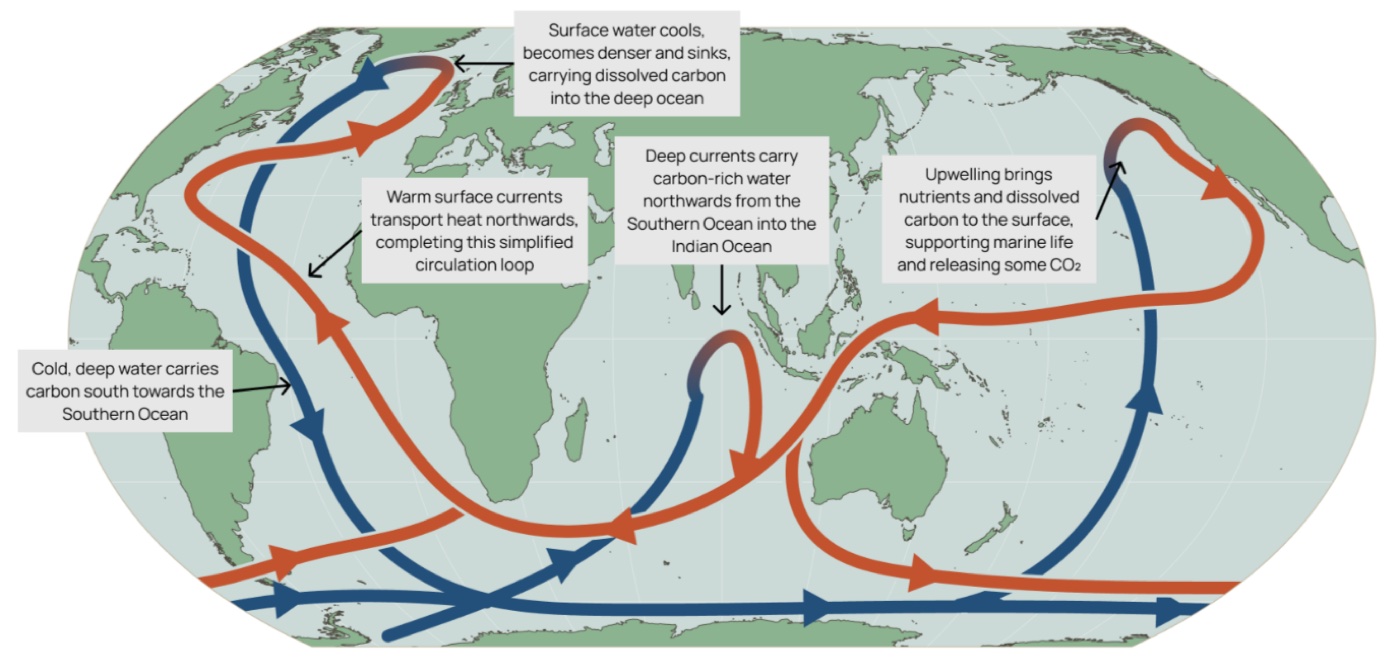
At a smaller scale, but no less important, microscopic organisms are performing an equally remarkable task. Phytoplankton - tiny photosynthetic organisms floating near the ocean surface - capture carbon dioxide through photosynthesis. Roughly half of Earth's oxygen production comes from the ocean, with photosynthetic plankton responsible for much of it. Phytoplankton also play a critical role in the marine carbon cycle. When they die, are eaten, or produce organic material, much of that carbon is recycled in surface waters, while a smaller proportion sinks into deeper waters through what scientists call the biological carbon pump. This process helps transfer carbon from the surface ocean into the deep ocean, where it can remain stored for long periods.
For many people, carbon storage is synonymous with forests. And forests are undeniably important. Trees absorb carbon dioxide and store carbon in their trunks, branches, leaves, and roots as they grow. But some remarkably carbon-dense blue carbon ecosystems are found not in tropical rainforests or mountain forests, but along coastlines.
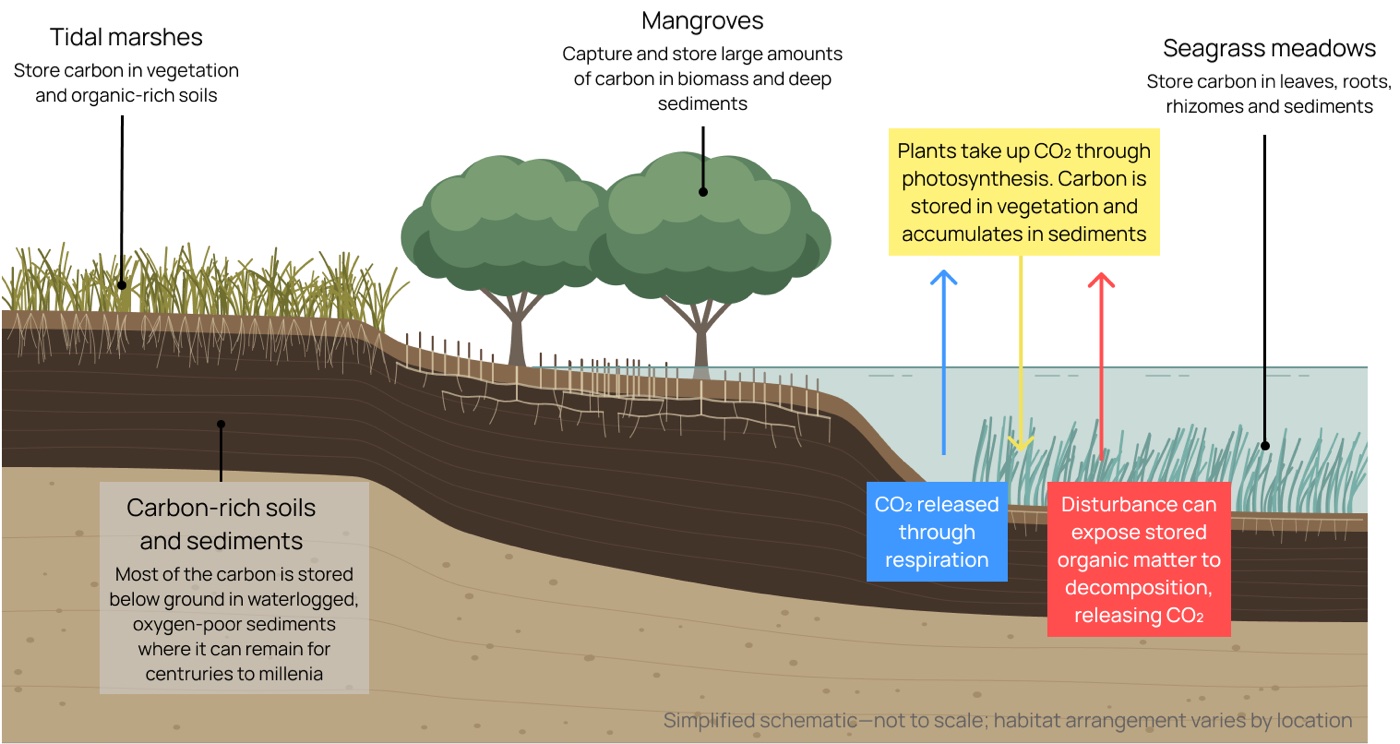
Mangroves, tidal marshes, and seagrass meadows are widely recognized as coastal blue carbon ecosystems because of their ability to capture and store carbon. Unlike many terrestrial ecosystems, where a large share of carbon is held in vegetation, coastal blue carbon ecosystems can store substantial quantities below ground in their soils and sediments. It is here, below the surface, that the story becomes particularly fascinating.
Beneath a mangrove forest lies waterlogged sediment that is often low in oxygen. In these conditions, organic matter can decompose much more slowly. Instead of rapidly breaking down and returning carbon to the atmosphere, carbon can accumulate in the sediment year after year, decade after decade, century after century. Coastal wetland soils can preserve carbon for hundreds to thousands of years. It is this hidden reservoir beneath the surface that makes mangroves such important carbon stores. UAE mangroves are part of this story too: research in the country's arid coastal ecosystems has found substantial carbon stocks in mangrove soils and biomass, even under the Gulf's extreme environmental conditions.
And yet, carbon is only part of the story.
Blue carbon projects are sometimes misunderstood. It can sound like a project designed solely to generate carbon credits or maximize carbon storage. In reality,, blue carbon projects are typically focused on the conservation, restoration, or sustainable management of coastal ecosystems that provide a far wider range of benefits. Mangroves help protect coastlines from erosion and storm impacts. They provide habitat and nursery areas for fish and wildlife. Coastal wetlands can improve water quality, support biodiversity, and contribute to coastal resilience. Carbon is one of the ecosystem services they provide, but it is rarely the only one.
This distinction is important because it highlights a broader truth about ecosystem restoration and management. Carbon is often one of the easiest outcomes to communicate, particularly when discussing climate change. It can be measured, modelled, monitored, and reported. But ecosystems do not exist solely to store carbon. A healthy mangrove forest is valuable not only because of the carbon beneath its roots, but because of everything else that those roots support.
For organizations working in restoration and conservation, this creates an interesting challenge. Before carbon can be quantified, habitats must be understood. Before change can be measured, there must be a baseline. Before a project can demonstrate impact, someone has to know where ecosystems exist, how healthy they are, and how they are changing through time.
This is where monitoring becomes essential.
Mapping habitat extent, assessing ecosystem health, tracking changes in vegetation cover, and understanding ecological condition are not simply scientific exercises. They are the foundation on which blue carbon assessments, restoration programs, and conservation strategies are built. At Nabat, this is where much of our work begins, using drone imagery, satellite data, and ecological field validation within NabatOS to map habitats, track their condition through time, and build the baselines that blue carbon assessments and restoration programs depend on. Whether the goal is biodiversity protection, climate resilience, restoration, or blue carbon, the starting point is ultimately the same: understanding what exists today and how it is changing.
This is particularly relevant in coastal environments around the Gulf. These ecosystems operate under extreme environmental conditions, characterized by high salinity, intense summer temperatures, and limited freshwater availability. Despite these pressures, Gulf mangroves store carbon, support biodiversity, and contribute to the resilience of coastal landscapes. Their structure, productivity, and carbon stocks can differ from mangrove systems in wetter tropical regions, which makes understanding local conditions especially important.
What makes carbon such a compelling lens through which to view these systems is that it connects everything. It links a mangrove root to a tidal flat, a phytoplankton cell to a deep ocean current, a restoration project to the atmosphere itself. It provides a thread connecting ecological processes occurring across vastly different scales, from microscopic organisms to planetary circulation systems.
Most of these processes are invisible to us. We cannot watch carbon moving through the atmosphere. We cannot see it being transported through deep ocean currents. We cannot observe it accumulating, atom by atom, beneath the roots of a mangrove forest.
Yet these hidden journeys influence our climate, shape our ecosystems, and determine the success of many of the restoration and conservation efforts taking place around the world today. Making them visible, through mapping, monitoring, and measurement, is where understanding begins, and it is what NabatOS is designed to support.
Understanding where carbon comes from is important.
Understanding where it goes may be even more important.
Because carbon never truly disappears.
It simply continues one of the most important journeys on Earth.
Interested in how NabatOS is helping organizations map, monitor, and understand coastal ecosystems, from mangrove extent to habitat condition and change over time? Get in touch with the Nabat team to learn how our ecosystem intelligence platform can support your conservation, restoration, and blue carbon programs.