%20--%3e%3cg%3e%3cg%20id='Layer_1'%3e%3cg%3e%3cg%3e%3cg%3e%3cg%3e%3cpath%20class='cls-1'%20d='M54.7,12.3c-1.4-1-3.3-1.6-5.5-1.6s-4.1.5-5.5,1.6c-1.7,1.2-2.5,2.9-2.5,5v11.8h5v-11.8c0-.4.1-.7.5-.9.6-.4,1.4-.6,2.6-.6s2,.2,2.6.6c.3.2.4.5.4.9v9.8c0,.5.2,1,.6,1.4.4.4.8.6,1.4.6h3v-11.8c0-2.1-.8-3.7-2.5-5Z'/%3e%3cpath%20class='cls-1'%20d='M75.4,11.1c-1,0-1.9.4-2.5,1.1-1.5-1.1-3.4-1.6-5.5-1.5s-4.4,1.1-6,2.7-2.7,4-2.7,6.5,1,4.9,2.7,6.7,4,2.7,6.6,2.7,3.4-.5,4.8-1.5c.6.7,1.4,1.1,2.5,1.1h1.7V11.1h-1.7ZM71.2,23.2c-.9.9-1.9,1.3-3.2,1.3s-2.3-.5-3.1-1.3-1.2-1.8-1.2-3,.4-2.3,1.2-3.1,1.9-1.3,3.1-1.3,2.2.4,3.1,1.3c.9.9,1.3,1.9,1.3,3.1s-.4,2.2-1.3,3.1h0Z'/%3e%3cpath%20class='cls-1'%20d='M89.5,10.7c-1.5,0-2.8.3-4,1v-6.8h-5v24.1h1.7c1,0,1.9-.4,2.5-1.1,1.5,1.1,3.2,1.6,5.2,1.5s4.7-1.1,6.3-2.8,2.7-4,2.7-6.5-.9-4.8-2.7-6.6c-1.8-1.8-4-2.7-6.6-2.7ZM92.6,23.2c-.9.9-1.9,1.3-3.1,1.3s-2.3-.5-3.1-1.3-1.3-1.9-1.3-3.1.5-2.3,1.3-3.1,1.9-1.3,3.1-1.3,2.3.5,3.1,1.3,1.3,1.9,1.3,3.1-.5,2.3-1.3,3.1Z'/%3e%3cpath%20class='cls-1'%20d='M116.3,11.1c-1,0-1.9.4-2.5,1.1-1.5-1.1-3.4-1.6-5.5-1.5s-4.4,1.1-6,2.7-2.7,4-2.7,6.5,1,4.9,2.7,6.7,4,2.7,6.6,2.7,3.4-.5,4.8-1.5c.6.7,1.4,1.1,2.5,1.1h1.7V11.1h-1.7ZM112.1,23.2c-.9.9-1.9,1.3-3.2,1.3s-2.3-.5-3.1-1.3-1.2-1.8-1.2-3,.4-2.3,1.2-3.1,1.9-1.3,3.1-1.3,2.2.4,3.1,1.3c.9.9,1.3,1.9,1.3,3.1s-.4,2.2-1.3,3.1h0Z'/%3e%3cpath%20class='cls-1'%20d='M157.2,11.1c-1,0-1.9.4-2.5,1.1-1.5-1.1-3.4-1.6-5.5-1.5s-4.4,1.1-6,2.7c-1.8,1.8-2.7,4-2.7,6.5s1,4.9,2.7,6.7,4,2.7,6.6,2.7,3.4-.5,4.8-1.5c.6.7,1.4,1.1,2.5,1.1h1.7V11.1h-1.7ZM153,23.2c-.9.9-1.9,1.3-3.2,1.3s-2.3-.5-3.1-1.3-1.2-1.8-1.2-3,.4-2.3,1.2-3.1,1.9-1.3,3.1-1.3,2.2.4,3.1,1.3c.9.9,1.3,1.9,1.3,3.1s-.4,2.2-1.3,3.1h0Z'/%3e%3cpath%20class='cls-1'%20d='M164.6,10.6c.8,0,1.5-.3,2.1-.9.6-.6.9-1.3.9-2.1s-.3-1.5-.9-2.1c-.6-.6-1.3-.9-2.1-.9s-1.5.3-2.1.9c-.6.6-.9,1.3-.9,2.1s.3,1.5.9,2.1c.6.6,1.3.9,2.1.9Z'/%3e%3c/g%3e%3cpath%20class='cls-1'%20d='M130.2,24c0,0-.2,0-.2.1-.3.2-1.8.3-2.3.3s-1.1-.1-1.4-.4c-.2-.2-.3-.6-.3-1.2v-6.8h2.4c.5,0,1-.2,1.4-.6.4-.4.6-.8.6-1.4v-3h-4.3v-1.6c0-.5-.1-1-.4-1.4-.7-1.1-1.7-1.6-2.8-1.6h-1.7v16.4c0,1.9.6,3.5,1.9,4.7,1.2,1.2,2.8,1.8,4.8,1.8s1.8,0,2.6-.2v-5.3Z'/%3e%3c/g%3e%3crect%20class='cls-1'%20x='162'%20y='11.6'%20width='5'%20height='17.6'/%3e%3cpath%20class='cls-1'%20d='M139.6,26.1c0,1.8-1.5,3.3-3.3,3.3s-2.6-.2-2.8-.2c0,0-.5-2.2-.5-3.1,0-1.8,1.5-3.3,3.3-3.3s2.8.1,3,.4c.2.4.4,2,.4,3Z'/%3e%3c/g%3e%3cpath%20class='cls-1'%20d='M29.3,17.5c-1.9,0-3.5,1.3-3.9,3h-.3c-2.8,0-5.3,1.2-7,3.1v-4.9c0-3.3.5-4.5,3.2-4.6.5,1.6,2,2.7,3.8,2.7s4-1.8,4-4-1.8-4-4-4-3.3,1.2-3.8,2.9c-1.3,0-2.3.3-3.1.7v-4.6c1.6-.5,2.7-2,2.7-3.8S19,.2,16.8.2s-4,1.8-4,4,1.2,3.3,2.9,3.8v4.6c-.8-.5-1.9-.7-3.3-.8-.5-1.7-2-2.9-3.8-2.9s-4,1.8-4,4,1.8,4,4,4,3.2-1.1,3.8-2.7c0,0,0,0,0,0,2.8,0,3.3,1.1,3.3,4.6v4.9c-1.7-1.9-4.2-3.1-7-3.1h-.7c-.4-1.7-2-3-3.9-3S0,19.3,0,21.5s1.8,4,4,4,3.1-1,3.7-2.5h.9c3.9,0,7,3.1,7,7v1.6h-4.2c-.7,0-1.2.5-1.2,1.2s.5,1.2,1.2,1.2h10.9c.7,0,1.2-.5,1.2-1.2s-.5-1.2-1.2-1.2h-4.2v-1.6c0-3.9,3.2-7,7-7h.5c.6,1.5,2,2.5,3.7,2.5s4-1.8,4-4-1.8-4-4-4ZM25,11.4c.9,0,1.6.7,1.6,1.6s-.7,1.6-1.6,1.6-1.6-.7-1.6-1.6.7-1.6,1.6-1.6ZM8.6,14.5c-.9,0-1.6-.7-1.6-1.6s.7-1.6,1.6-1.6,1.6.7,1.6,1.6-.7,1.6-1.6,1.6ZM4.1,23.1c-.9,0-1.6-.7-1.6-1.6s.7-1.6,1.6-1.6,1.6.7,1.6,1.6-.7,1.6-1.6,1.6ZM16.8,5.7c-.9,0-1.6-.7-1.6-1.6s.7-1.6,1.6-1.6,1.6.7,1.6,1.6-.7,1.6-1.6,1.6ZM29.3,23.1s0,0,0,0c0,0,0,0,0,0,0,0-.1,0-.2,0,0,0,0,0,0,0-.8-.1-1.3-.8-1.3-1.5s.6-1.5,1.4-1.6c0,0,0,0,0,0,0,0,0,0,0,0s0,0,0,0c0,0,0,0,0,0,.9,0,1.6.7,1.6,1.6s-.7,1.6-1.6,1.6Z'/%3e%3c/g%3e%3c/g%3e%3c/g%3e%3c/svg%3e)

When people think about restoration, they usually think about the moment a drone takes off, a seed is planted, or a landscape begins to change.
What is less visible is everything that happens beforehand.
Long before a single mangrove establishes itself along a coastline, there are months of ecological assessments, seed collection campaigns, permitting, site selection exercises, engineering tests, deployment planning, and monitoring system development. Restoration is often measured in hectares restored, but those hectares begin with something much smaller: a seed.
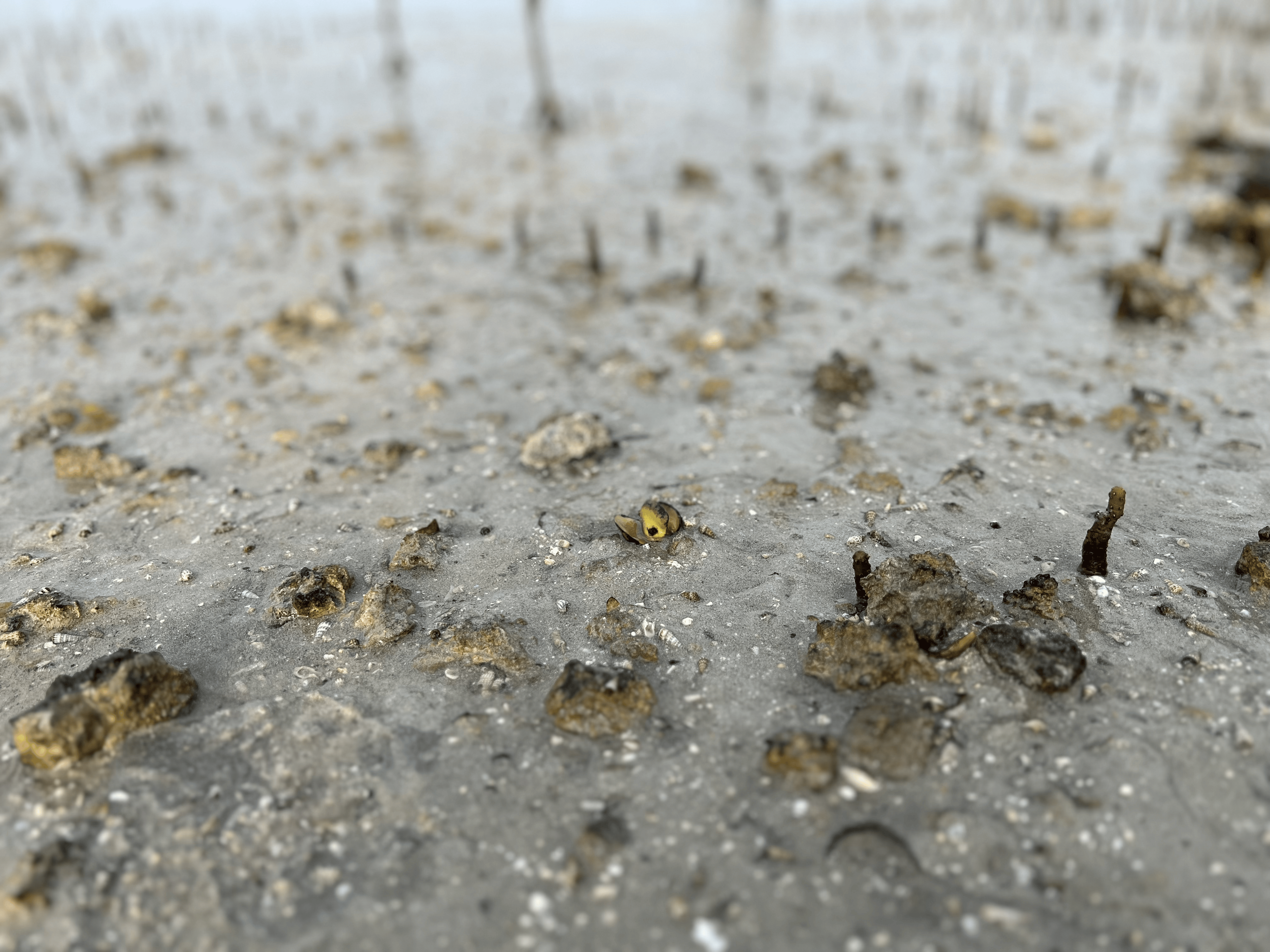
A mangrove propagule - the starting point of every restoration journey.
At Nabat, we have spent the last several years building technologies designed to make restoration more measurable, scalable, and adaptive. Increasingly, that means understanding the entire lifecycle of a restoration program - from identifying suitable sites and sourcing propagules to deploying seeds and monitoring what happens afterwards.
The journey begins with seed collection.
For mangrove restoration programs in the UAE, seed collection must be approached carefully. Healthy mangrove stands are not simply seed sources; they are functioning ecosystems that must continue to regenerate naturally. For previous collection campaigns, our ecology team estimated annual propagule production across candidate collection sites and established conservative collection targets designed to protect long-term ecosystem health. Only a proportion of the available propagules are collected, ensuring that restoration activities do not compromise the resilience of the source populations.
Once collected, those propagules begin a process that is rarely seen by the public. Teams coordinate logistics, transport, storage, viability considerations, health and safety procedures, and site preparation activities. Every stage matters. A propagule collected at the wrong time, handled incorrectly, or stored under unsuitable conditions may never contribute to restoration outcomes.
Yet collecting seeds is only one part of the challenge. The next question is often more difficult: where should they go? This is where restoration begins to move from logistics to intelligence. Not every coastal environment is suitable for mangrove restoration. Hydrology, tidal inundation patterns, existing vegetation communities, sediment dynamics, and environmental disturbance all influence long-term establishment. Simply dispersing more seeds does not guarantee success.
Nabat uses satellite-derived land cover analysis and tidal inundation modeling to identify areas with the highest restoration potential before seeding operations begin.
Through NabatOS, multiple ecological datasets can be combined into a single decision-making framework, helping restoration teams move beyond intuition and toward evidence-based site selection.
In many ways, this is one of the most important parts of restoration. By the time a seed reaches the ground, many of the conditions that will determine its success have already been set.
Once suitable sites are identified and propagules prepared, attention shifts to deployment.
At landscape scale, this creates a new set of challenges.
Deploying millions of seeds across large restoration sites requires more than drones. It requires engineering systems capable of releasing seeds accurately, consistently, and repeatedly under demanding field conditions.
Nabat's hardware team continues to refine the mechanical systems that support aerial restoration. The goal is simple: ensure that seeds are distributed predictably across a site, maximizing restoration effectiveness while minimizing waste. Achieving this is more complex than it might appear. Different seed types behave differently inside a deployment mechanism. Flow rates must remain stable, mechanical components must withstand repeated field operations, and distribution patterns must remain consistent across flights. To address these challenges, the team has been testing new dispensing mechanisms, interchangeable brush systems, and improved hardware configurations designed specifically for ecological restoration. Every improvement helps strengthen the link between planning and operational delivery.
But even with the best hardware in the world, a fundamental question remains: how do you know how many seeds reached the ground?
Historically, restoration programs could estimate how many seeds were loaded into a drone. Verifying how many propagules were dispersed - or where they landed -was significantly more difficult.
This challenge became the starting point for one of NabatOS' newest monitoring capabilities.
Our team has been developing an AI-powered seed detection model capable of identifying individual mangrove propagules from ultra-high-resolution drone imagery. At first glance, this sounds straightforward. In practice, it is remarkably difficult. Mangrove propagules typically measure only 2.2 to 3.5 centimeters in width and are often surrounded by complex coastal backgrounds including sediment, debris, shadows, vegetation, and water.
To build the model, the team manually labeled 3,113 propagules across imagery collected from Abu Al Abyad. This represented a significant expansion from the original proof-of-concept dataset of 611 seeds and created one of the largest specialized datasets available for this type of restoration monitoring.
The objective was not simply to identify seeds. The objective was to make restoration measurable.
Using advanced AI and computer vision techniques, the system was trained to identify individual propagules across ultra-high-resolution imagery, enabling them to be detected and assessed efficiently across restoration sites.
The results exceeded our initial expectations. The system detected 98% of propagules in the test dataset, while further refinement improved precision from 74% to 90%, achieving an F1 score of 0.93. More importantly, the system demonstrated its practical potential to support restoration monitoring in operational conditions.
When tested against manually counted post-seeding imagery, the model correctly identified 420 of 457 propagules, achieving a counting accuracy of approximately 92%.
For us, this is where the technology becomes meaningful.
The most exciting outcome is not the accuracy metric itself. It is what the metric enables.
For the first time, restoration teams can begin connecting seed collection, deployment, and verification within a single workflow. NabatOS can help identify where restoration should occur, support deployment planning, record flight operations, analyze ultra-high resolution monitoring imagery, and estimate propagule counts following seeding activities.
In other words, the entire restoration lifecycle becomes increasingly measurable.
That matters because restoration is ultimately an exercise in learning. Every propagule collected represents a hypothesis. Every flight tests that hypothesis. Every monitoring campaign generates evidence. And every season provides an opportunity to improve the next one.
The future of restoration will not be defined solely by how many hectares are planted. It will be defined by how well we understand what happens after implementation. By connecting ecology, engineering, drone operations, AI, and monitoring through NabatOS, we are working towards a restoration process where every stage can be measured, evaluated, and improved.
Because every restoration project starts with a single seed.
The real challenge - and the real opportunity - is understanding everything that happens next. Interested in how NabatOS is helping organizations monitor restoration at scale? Contact the Nabat team to learn how our ecosystem intelligence platform combines ecology, AI, UAV operations, and monitoring to support data-driven restoration programs.
This is part of AI with Muddy Boots, our series on what it takes to understand and restore the ecosystems we work in. Follow along for more, and reach out to our team of restoration, ecology, and technology experts to discuss what this could look like across your landscape and programs.